Next blog post

Why a pre-opening website is essential, and what to consider for branding, domain names, visibility and social media
Construction is on schedule. The interior has been chosen, the team is being assembled and the opening date is in the diary. Yet online, the hotel doesn't exist yet. And that is exactly where guests, corporate bookers, event planners, journalists and future employees start looking for information, months before the opening.
Building online visibility takes time. A new domain has to earn Google's trust, a brand needs to become recognisable and a community won't follow you overnight. The only time you have for that is before the opening. Wait until the first guest checks in, and you start from zero online, playing catch-up from day one.
In this article, you'll read what to look out for as a hotel developer, owner or operator: from brand name and domain names to pre-opening website, visibility (AI and search engines), social media and technology. We show how we approach this at Becurious, with two examples from our own work, and close with a preview of our pre-opening checklist.
Don't feel like reading it all? Schedule a call with us right away.
A hotel opens on a single day, but demand for that hotel arises much earlier. If you don't capture that demand online, you miss opportunities, or hand them to the OTAs.
Google and AI models need time. A new domain has to build authority before it ranks well. The same applies to language models such as ChatGPT, Gemini and Claude: they only get to know and recommend a hotel once there is enough reliable information about it online, on its own website and on external sources. Every month your pre-opening website is live earlier is a month's head start on opening day.
Groups and events book ahead. Business meetings, weddings and group trips are often planned six to twelve months in advance. Without a website and a way to submit an enquiry, you simply aren't on the radar.
Direct bookings from day one. A hotel that is already known online doesn't have to rely entirely on booking platforms and their commissions at opening. An established mailing list delivers the first bookings through your own channels.
Recruitment starts early. Finding good staff for a hotel that doesn't exist online is difficult. A pre-opening website with vacancies and a strong story makes all the difference.
Press and partners need something to refer to. Journalists, bloggers, tour operators and business partners look for a reliable source with up-to-date information and imagery.
The pre-opening isn't a moment, but a process with several phases. The earlier you start, the calmer the run-up to the opening. As a guideline, we use this sequence:
Is the opening already closer? Then you go through the same steps in less time.
Everything online starts with a clear brand. Positioning, target audience and tone of voice determine what your website looks like, what content you create and how you communicate on social media. Lay that foundation before the first design is made.
The brand must align with the hotel's story and brand promise, and appeal to the guests you want to welcome. From this follows a visual identity that works online and offline: on the website, in social posts, on signage and in print. At Becurious, we develop hotel brands from that story, from positioning to visual identity, with the website and online visibility in mind from the start.
When it comes to the name itself, a few questions are crucial:
Is the hotel part of an existing collection or chain? Then decide early on how the new hotel relates to the existing brand architecture, so you don't have to restructure later.
The domain name is the foundation of your online presence. A wrong choice or a later change costs you search rankings, trust and time.
Set up a professional email domain straight away too, including the right settings (SPF, DKIM and DMARC). That way, booking confirmations, quotes and newsletters land in the inbox, not in the spam folder. Most hotels work with a system administrator or specialised IT partner for this.
A pre-opening website is more than a page saying "opening soon". It is your hotel's first calling card, a sales tool for groups and events, a recruitment channel for staff and the basis for your visibility after the opening.
At the very least, it should include:
Build on, don't start over. The pre-opening website and the full website share the same domain, the same structure and the same set-up. While the pre-opening website is live and building visibility, we work on the full website behind the scenes, in a separate CMS environment with a staging website. At the opening, the full website goes live on the same domain, so all the visibility you have built up is retained. With Porter, our template system for hotel websites, the pre-opening website is also live in no time.
Plan the moment for real photography. In the pre-opening phase, you work with renders and mood images. Schedule the photo shoot as soon as possible after the first rooms and public spaces are completed, and replace the renders step by step.
Think multilingual from the start. Expecting international guests? Then include translations from the very first version, so those pages get indexed early too.
Visibility isn't built in a few weeks. The earlier you start, the stronger your position on opening day.
SEO starts with the pre-opening website. Search engines need to get to know and trust your domain. Write content about the hotel, the neighbourhood and the reasons to stay right there. That way, you will rank not only for your own name, but also for searches like seaside hotel in Zeeland or boutique hotel in Eindhoven.
Earn links. Press coverage, partners, the local council, local businesses and tourism organisations are valuable sources of links to your website. A new hotel is news, so make the most of it.
Think about GEO. More and more guests do their research via AI assistants such as ChatGPT, Gemini and Google's AI Overviews. Generative Engine Optimisation ensures these systems know your hotel and describe it correctly. That requires clear, consistent information, structured data on your website and mentions on reliable external sources.
Claim your Google Business Profile. Create the profile in good time and add the opening date, so the hotel appears as opening soon in Google Maps and search results.
Keep your details consistent everywhere. Name, address, phone number and website must be exactly the same on all platforms. Small differences cause confusion for guests, search engines and AI systems.
How does this work out in practice? Two hotels for which we built the pre-opening website: one that has since opened, and one that is in the middle of the run-up to its opening.
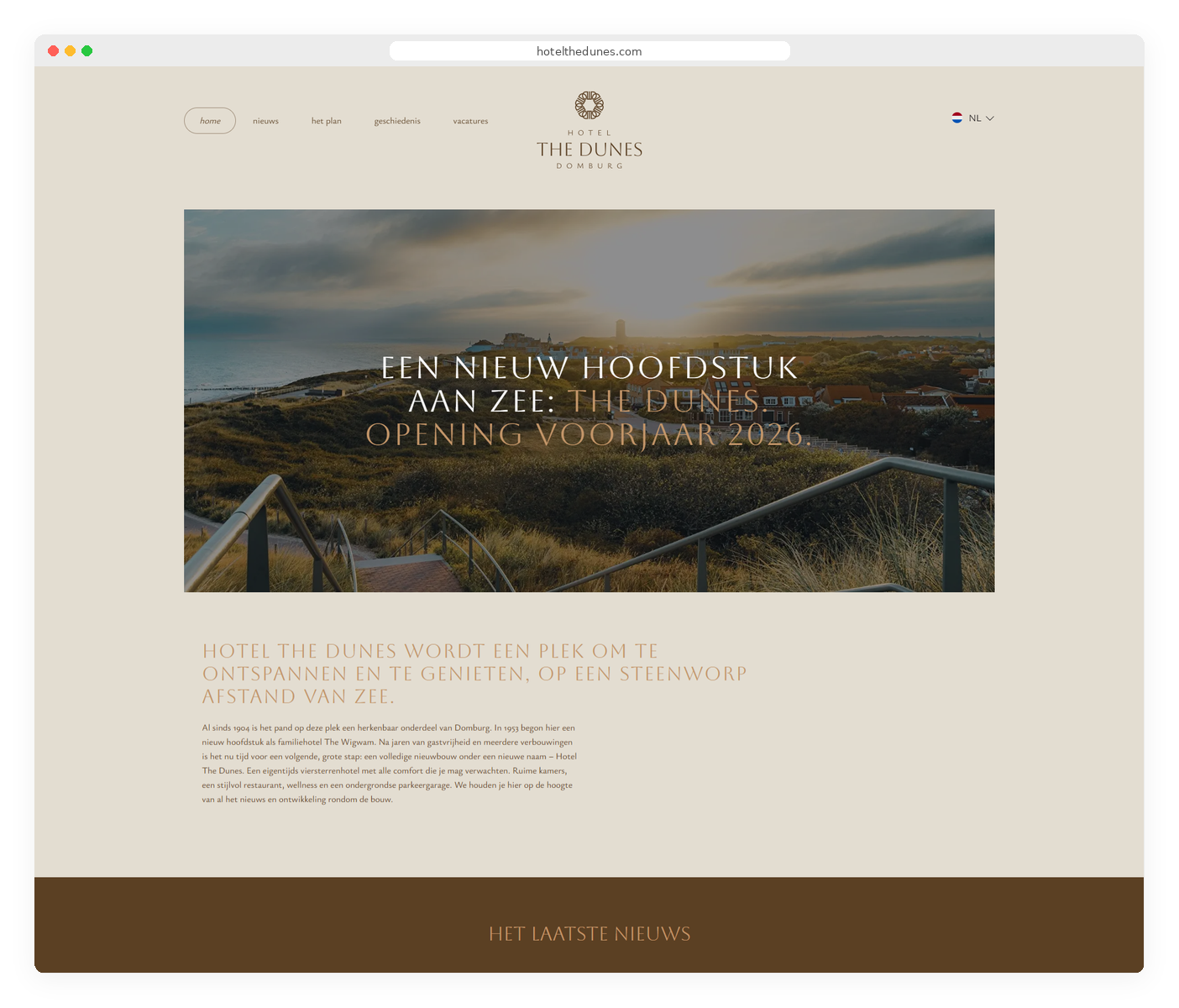
Hotel The Dunes in Domburg opened its doors on 24 May 2026. Online, we built up to that day in three phases, following exactly the timeline in this article.
Phase 1: pre-opening website (from October 2025). More than six months before the opening, the pre-opening website went live. Visitors followed construction month by month, signed up for the newsletter and found the first vacancies. Up to the launch of the full website, it attracted more than 5,600 visitors, accounting for over 10,000 visits. Half of these already came via organic search in Google, while the newsletter brought in almost 2,500 visits.
Phase 2: full website (from 14 January 2026). The full website went live on the same domain, including the booking module. The four months up to the opening brought more than 15,500 visits and 64 direct bookings, before a single guest had checked in.
Phase 3: opening (24 May 2026). Since the opening, that foundation has been built on further, with more than 560 direct bookings via the hotel's own website. AI assistants now know the hotel too: more than 600 visitors arrived via ChatGPT, also leading to bookings.
We remain involved after the opening too. Through Becurious Performance, we provide additional digital marketing, so the hotel gets even more return from its website.
View the Hotel The Dunes website.
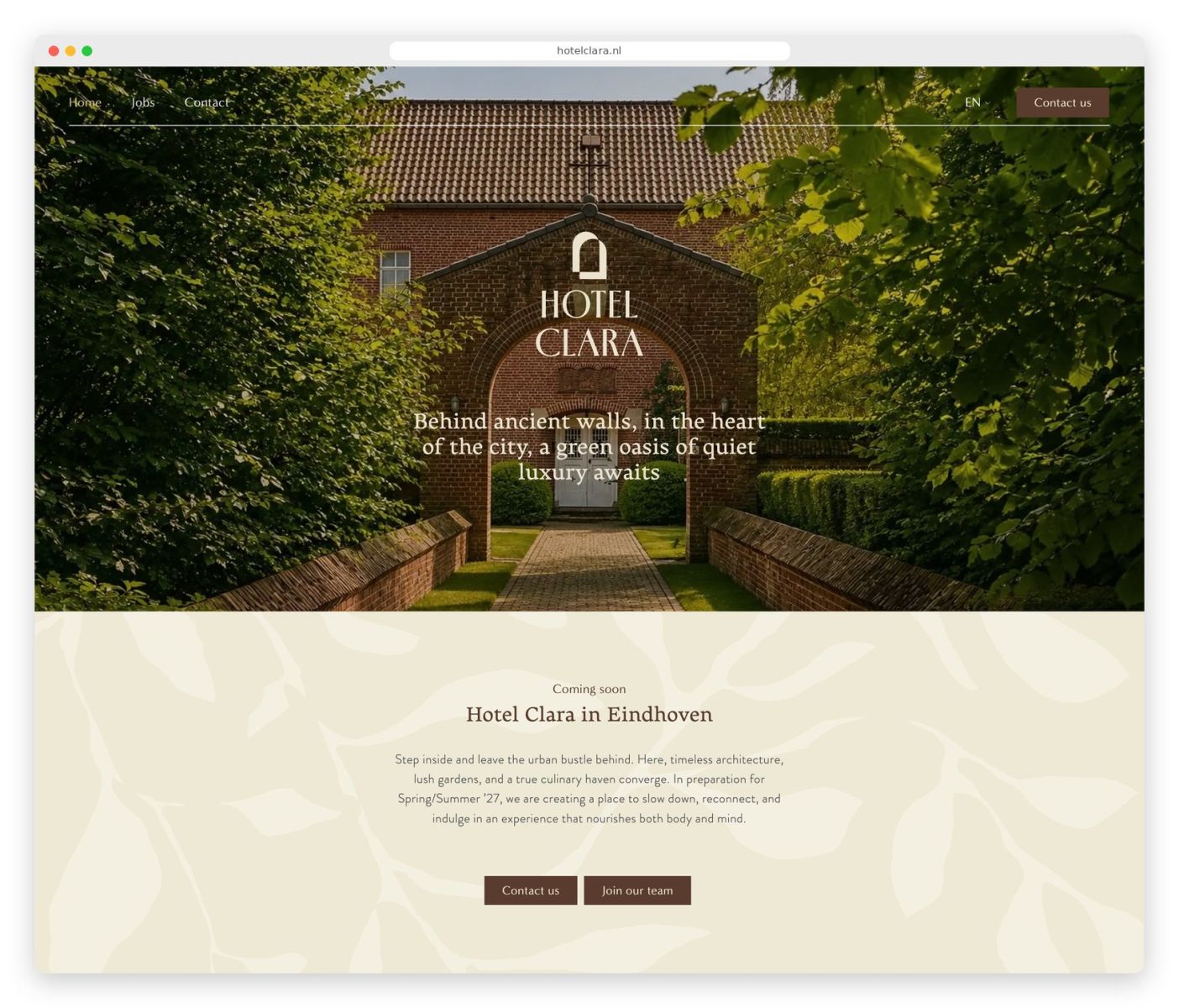
Hotel Clara in Eindhoven opens in spring or summer 2027 and is currently in the middle of its pre-opening phase. Behind historic walls, in the heart of the city, a green oasis is taking shape, and the website already tells that story. Visitors can get in touch and apply for jobs, while we work on the full website behind the scenes. View the Hotel Clara pre-opening website.
In the pre-opening phase, social media is your stage. You show what's coming, build curiosity and make sure an audience is already waiting at the opening.
Behind a good website lies a solid technical foundation. Make those choices too late, and you'll face unnecessary stress around the opening.
The opening isn't the finish line, but the moment everything comes together. Everything you built up in the pre-opening phase now comes into play.
Take your soft and grand opening online. Inform your mailing list first, then your followers and the press. Give your first fans a reason to be the first to book.
Start performance marketing. Google Ads, social campaigns and metasearch accelerate initial occupancy. Because your tracking is already in place, you see immediately what works.
Build reviews from day one. The first reviews largely determine how future guests see your hotel. Actively ask for feedback and respond to every review.
Adjust based on data. Which pages convert, where do visitors drop off, which channels deliver bookings? Use those insights to fine-tune your website and campaigns in the first months.
With more than twenty-five years of experience, we at Becurious have developed a standard checklist that we use for every hotel opening. It is organised by phase, with a timeline and clear responsibilities. A sneak peek:
The full checklist goes a lot further, with all relevant points spread across the phases, from first sketch to the months after opening. We are happy to go through it with you personally, tailored to your hotel and your planning.
The first guest only checks in on opening day, but the journey to that first booking starts months earlier. With a strong brand, the right domain names, a pre-opening website that grows with you and a well thought out approach to visibility and social media, you open online long before the doors do.
Are you developing a new hotel, or is an opening on the horizon? Get in touch with Becurious. We would be happy to go through the full pre-opening checklist with you in a personal conversation, and look together at what your hotel needs to be found and booked from day one.

 English
 Nederlands